
Why Industrial LPG Setups Can’t Afford a Weak Regulator
In a home kitchen, a weak regulator is annoying. Flame sputters a bit, you swap the cylinder, life goes on. In an industrial setup, that same weak point isn't an inconvenience, it's a liability sitting quietly in the system until the day it isn't quiet anymore. Industrial LPG lines run longer, harder, and under far more demand than anything in a domestic setup, and the regulator sitting at the heart of that system either keeps up or becomes the reason something goes seriously wrong.
This is really the whole conversation worth having before anyone assumes a cheaper regulator saves money. It doesn't, not when you actually account for what's riding on it.
Industrial Demand Isn't Like Domestic Demand
A home setup might run a stove for an hour or two a day. An industrial operation can have LPG lines running for full shifts, sometimes around the clock, feeding equipment that depends on consistent, controlled flow to function properly at all. That's a completely different kind of stress on a regulator than anything it'd see in a kitchen.
A weak regulator under that kind of sustained demand doesn't fail gracefully. It fails under pressure, often literally, and the gap between "working fine" and "failing" can be a lot narrower than people expect once a component's already being pushed past what it was built for.
What Actually Happens When a Regulator Can't Keep Up
A regulator that can't hold steady output under industrial load creates flow inconsistencies, and those ripple straight into whatever equipment depends on that gas. Inconsistent flow means inconsistent heat, inconsistent performance, and in processes where precision actually matters, inconsistent results coming out the other end. That's expensive on its own before anything even breaks.
Then there's the more serious version of this. A regulator that's degrading internally, whether from corrosion, worn seals, or just not being rated for the pressure it's handling, risks leaking. In an industrial environment, with larger gas volumes and more potential ignition sources around, a leak isn't a minor fix-it-later problem. It's the kind of thing safety protocols exist specifically to prevent.
Why Brass Construction Isn't Optional Here
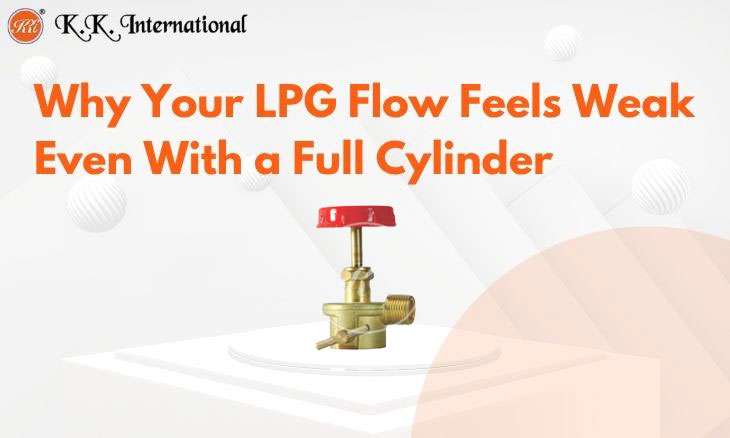
This is where material actually becomes a safety decision, not just a durability one. A regulator built from solid brass, like the one from KK International, holds up against corrosion and sustained pressure in a way that cheaper materials simply can't match over months and years of continuous industrial use. Brass doesn't degrade the way lower-grade alloys do when they're exposed to constant handling, temperature shifts, and the kind of wear an industrial environment throws at equipment daily.
This isn't a small detail buried in a spec sheet somewhere. It's really the difference between a regulator that holds its rated performance for years and one that starts showing weakness within months, right around the time an operation has stopped paying close attention to it because it seemed fine at first.
The Cost of Replacing a Weak Regulator vs. the Cost of It Failing
Here's the math that should settle this pretty quickly. A quality regulator costs a modest amount upfront. A regulator failure in an industrial setting costs downtime, potential equipment damage, safety investigations, and in the worst cases, something no amount of money actually fixes afterward. Weighed against each other, there's really no contest.
Industrial operations that treat the regulator as just another line item to minimize cost on are making a decision that looks fine on a spreadsheet and terrible in practice. This is one of the few components in a system where cutting corners doesn't quietly save money, it just defers a much bigger cost to a worse moment.
Consistency Matters More at Industrial Scale
A domestic regulator just needs to work. An industrial regulator needs to work the same way every single time, under full load, for years, without drifting out of its rated range. That consistency is what keeps equipment calibrated correctly and keeps processes repeatable, which matters enormously in any operation where output quality depends on steady, predictable inputs.
A regulator built to handle high-temperature resistance and sustained pressure, with universal compatibility across different equipment brands, gives an operation that consistency without forcing a rebuild of the whole gas delivery setup just to accommodate one part. That flexibility matters more in industrial settings than people tend to realize until they're stuck without it.
Why This Decision Deserves More Attention Than It Usually Gets
A regulator is a small, unglamorous part of a much bigger industrial system, and that's exactly why it gets overlooked so often when budgets are being decided. But it's also one of the few components where the margin for failure is genuinely thin, and the consequences of that failure scale up fast in an industrial environment compared to a domestic one.
If an operation is running LPG at industrial scale, the regulator isn't the place to look for savings. It's the place to look for reliability, because everything downstream of it, equipment performance, safety, uptime, depends on that one part doing its job correctly every single time.
Running an industrial LPG setup and want a regulator built to handle real demand? Reach out to the KK International team, they can help you find the right fit for your system.


